
Key takeaways
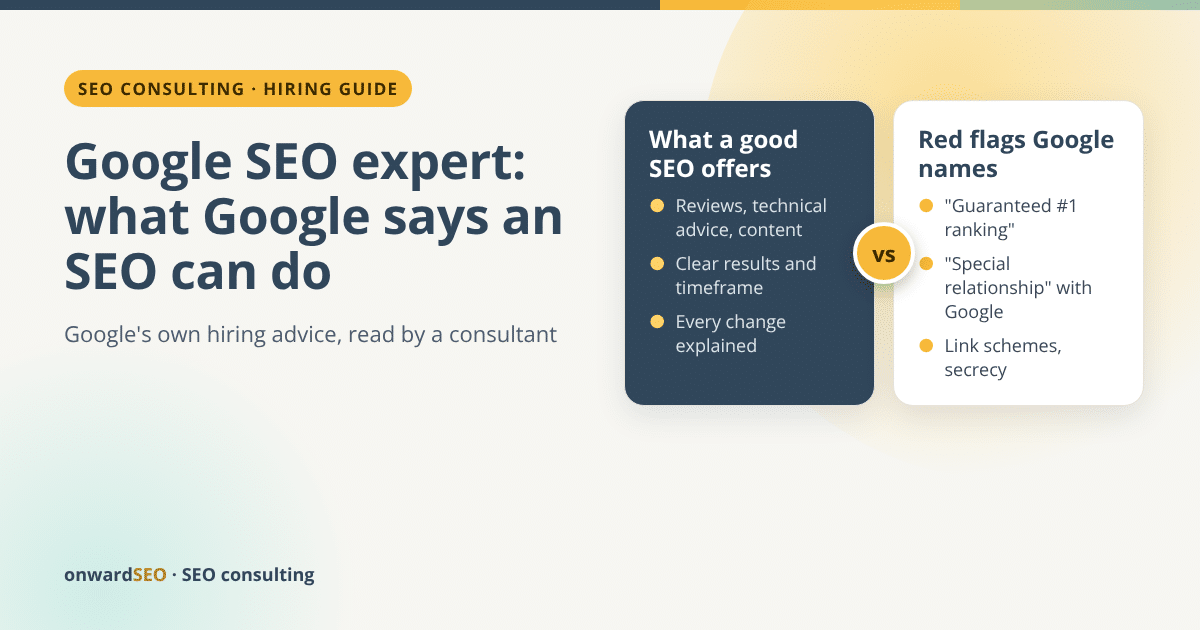
- A real Google SEO expert has no special status with Google. Google says no one can guarantee a #1 ranking and warns against anyone claiming a special relationship with Google.
- Google’s own page lists what an SEO can legitimately do: reviews of content and structure, technical advice, keyword research, training, market expertise and optimising for generative AI.
- Ask the questions Google suggests, and expect every change to your site to be shared and explained.
- For an audit, give read access to Search Console only. Keep ownership and write access yourself.
- You stay responsible for what anyone you hire does to your site, so cheap shortcuts are your risk, not theirs.
If you are looking for a Google SEO expert, the most useful document you can read before any sales call is written by Google itself. Its page Do you need an SEO? sets out what a search engine optimisation specialist can do for you, what to ask them and which promises should make you walk away.
I have worked in SEO and digital marketing for more than 16 years, and I still send prospects to that page. It protects them from bad hires and describes the work I want to be judged on. Below I go through it and add what it means when you are the one signing the contract.
What a Google SEO expert really is (and isn’t)
“Google SEO expert” is a phrase people search for, not a job title Google hands out. A good SEO expert knows how Google Search works, follows Google’s published rules and can explain every recommendation in plain language. There is no badge, partner tier or certificate that makes an SEO “official”.
Google is direct about this. Its hiring page says that “No one can guarantee a #1 ranking on Google” and tells you to be wary of SEOs who “allege a ‘special relationship’ with Google, or advertise a ‘priority submit’ to Google.” It also says that Google “never accepts money to include or rank sites in our search results” and that advertising with Google won’t have any effect on your site’s presence in organic results.
So when someone sells you “Google SEO”, ask what they mean. Google’s own rules, done well: good. Access, influence or a shortcut: walk away.
How does search engine optimization work, in Google’s own words
To judge an SEO you need a rough model of what they try to influence. Google’s guide to how Search works describes three stages, and adds that “not all pages make it through each stage”:
- Crawling. Google “downloads text, images, and videos from pages it found on the internet with automated programs called crawlers.”
- Indexing. Google analyses those files and stores what it learns in the Google index, a large database.
- Serving. When someone searches, Google returns the information it judges relevant to the query.
The same page says that “Google doesn’t accept payment to crawl a site more frequently, or rank it higher”, and that Google doesn’t guarantee it will crawl, index or serve your page even if you follow its rules.

That is the honest description of the job. An SEO expert removes what stops Google from crawling your pages, make sure the right pages get indexed, and improve the content and signals that decide whether you are a good answer when the page is served. Good work raises your odds. Nobody can promise the outcome.
What Google says an SEO can do for you
Google’s page lists the services an SEO or agency may offer. Here is that list, with what each one looks like in practice and the question I would ask about it.
| Service on Google’s list | What it looks like in practice | Question to ask |
|---|---|---|
| Review of your site content or structure | An audit of pages, navigation, internal links and duplicates | Which pages would you change first, and why? |
| Technical advice on development (hosting, redirects, error pages, JavaScript) | Fixes your developer can implement and test | Will you write tickets my developer can act on? |
| Content development | Briefs or pages written for real searches and real customers | Who writes, and who checks facts? |
| Management of online business development campaigns | Coordinating SEO with other channels | How do you report on what each channel did? |
| Keyword research | A list of searches tied to pages and business value | How do you decide which keywords are worth it? |
| SEO training | Teaching your team to keep the basics right | What will we be able to do ourselves afterwards? |
| Expertise in specific markets and geographies | Local, national or international setups | Have you worked in my country or language? |
| Optimising for generative AI | Making content clear and citable in AI features | What exactly will you change, and how will we see it? |
Not on the list: guaranteed positions, secret techniques, “submissions” to Google or bulk links. If a proposal can’t be mapped to rows in that table, ask what you are paying for.
For most sites the first useful step is a review, which is what our SEO website audit covers: a written list of issues, ranked by impact, with the reasoning behind each one.
The red flags Google names
The second half of Google’s page lists warnings. These are the ones I see most often in proposals prospects forward to me.

Guarantees and “special relationships”
Any promise of a first-place ranking, a fixed number of page-one keywords by a date, or privileged access to Google contradicts Google’s own words. Google’s advice on audits is the same: if an SEO guarantees that their changes will give you first place in search results, find someone else.
Secrecy
Google says you should ask for explanations, and that an SEO with FTP access to your server should be willing to explain all the changes they make. If the plan is “trust us, it’s proprietary”, you can’t check the work and you can’t take it with you if you leave.
If an SEO can’t explain a change to you in two sentences, it shouldn’t be on your website.
Deceptive content and link schemes
Google warns that “If an SEO creates deceptive or misleading content on your behalf, your site could be removed entirely from Google’s index”, and that you are responsible for the actions of any companies you hire. It also says to avoid SEOs who talk about link popularity schemes or submitting your site to thousands of search engines.
Google’s spam policies define link spam as “creating links to or from a site primarily for the purpose of manipulating search rankings”, including buying or selling links for ranking purposes. Sites that break these policies “may rank lower in results or not appear in results at all.” If you are already there, our Google penalty recovery work starts with finding exactly what triggered it.
Cold emails
Google’s advice: “Be wary of SEO firms and web consultants or agencies that email you out of the blue.” An unsolicited “your site has critical errors” email is a sales script, not an audit.
The questions to ask before you hire
Google suggests a short list of questions. I expect to be asked every one of them myself.
Google's questions for a prospective SEO
- Can you show me examples of your previous work and share some success stories?
- Do you follow the Google Search Essentials?
- What kind of results do you expect to see, and in what timeframe? How do you measure your success?
- What’s your experience in my industry, in my country or city, and with international sites?
- How long have you been in business?
- How can I expect to communicate with you? Will you share all the changes you make to my site, with the reasoning behind your recommendations?
- Are they interested in you and your business? If not, Google says to find someone who is.
Two do most of the filtering: “what results, and when?” separates planners from promisers, and “will you share all the changes?” separates open work from secret work. Google also suggests asking past clients whether the SEO was useful, easy to work with and produced positive results.
On measurement, agree how progress will be reported before work starts. Our walkthrough of how to read a rank tracking report shows what a useful report contains, and why a position only means something next to the previous check.
What access to give an SEO (and what to keep)
Google’s hiring page gives one practical rule that many businesses miss: for an audit, “only grant read access to Search Console (at this stage, don’t grant them write access).” Search Console’s help page on owners, users and permissions explains the levels.

| Permission | What Search Console Help says it allows | When an SEO needs it |
|---|---|---|
| Restricted user | “Simple view rights on most data” | Enough for a first audit |
| Full user | “View rights to all data” and can take some actions, such as submitting a sitemap or requesting a reconsideration | Once you have agreed an ongoing scope |
| Owner | “Full control over properties”, including adding and removing users | Keep this for your own organisation |
The same logic applies to your CMS, hosting and analytics: give the lowest level that lets the work happen, use named accounts, and remove access when the engagement ends.
When hiring an SEO is worth it, and when it isn’t
Google’s page says something that a lot of SEO sellers would rather you didn’t read: if you run a small local business, you can probably do much of the work yourself, and Google recommends starting with its own SEO Starter Guide. I agree. Learn the basics first: you will make a better hire later, or find you don’t need one.
Hiring tends to pay off:
- Before a redesign or migration. Google says “a great time to hire is when you’re considering a site redesign (the earlier, the better).” Most traffic losses I am asked to fix after a relaunch could have been prevented with a redirect plan and a pre-launch check.
- When the problem is technical. Crawling, indexing, JavaScript rendering, large catalogues and international setups are where experience saves the most time.
- After a drop you can’t explain, including a manual action or a sustained fall after an update.
It is usually not worth paying for “monthly SEO” that is a ranking report plus unplanned blog posts, or for anything sold on the number of links delivered.
How I work, measured against Google’s list
I charge by the hour, with no fixed packages, so you pay for the work your site needs rather than a bundle. I follow Google Search Essentials and cite Google’s documentation when I recommend something. Every change I suggest comes with the reason behind it, written so your developer or content team can act on it. My background is listed on my profile page: technical SEO, crawl budget, content strategy, link building, digital PR and analytics, on WordPress, Magento and Shopify. You can read more on our SEO experts page.
And I will tell you when you don’t need me.
FAQ
Does Google hire SEO experts to rank websites?
No outside SEO ranks your site on Google’s behalf. Google says it never accepts money to include or rank sites in its search results, and it tells you to be wary of anyone who claims a special relationship with Google. An SEO expert works on your site, not inside Google.
How does search engine optimization work in simple terms?
Google crawls pages, indexes what it finds and serves the most relevant results when someone searches. SEO is the work of making sure Google can reach your important pages, understands them and has good reasons to show them for the searches your customers make. It improves your chances at each stage but can’t force any of them.
Can an SEO guarantee a first-page or #1 ranking?
No. Google states that no one can guarantee a #1 ranking on Google, and it says that if an SEO guarantees their changes will give you first place, you should find someone else. A good SEO sets expected outcomes, a timeframe and a way to measure them, and explains the risks.
Is there a Google certification for SEO experts?
Google certifies people in some of its products, such as Google Analytics IQ (one of mine), but that says nothing about ranking skill. Google also says it doesn’t evaluate or endorse third-party SEO tools, so be wary of any tool or person presented as “approved by Google”.
What should I check before hiring an SEO?
Ask Google’s questions: past work, whether they follow Google Search Essentials, expected results and timeframe, relevant experience, how long they have been in business, how they communicate and whether they will explain every change. Then check references and start with read-only access.
If you are about to hire an SEO and want a second opinion on a proposal, or want to know whether you need one at all, talk it through with me first.
Eugen Platon · SEO consultant with 16+ years in SEO and digital marketing · free 10-minute first call

Eugen Platon
Latest posts by Eugen Platon (see all)
- AI Overview Tracking: What ‘Cited #2 of 7’ Tells You About Your Traffic - October 19, 2026
- onwardSEO vs SERPRobot: When a SERPRobot Alternative Makes Sense (and When It Doesn’t) - October 19, 2026
- How to Check Keyword Rankings Accurately: 4 Methods and Where Each One Breaks - October 19, 2026
- SEO Companies for Small Business: How to Shortlist Without Getting Burned - October 18, 2026