
Key takeaways
- Judge seo companies for small business on proof you can check yourself, not on a sales deck or a reviews page.
- Ask for live examples, a sample report and two references, then verify each one before you sign anything.
- Walk away from guaranteed rankings, secret methods, cold emails and anyone who wants to buy links for you.
- Give a new SEO restricted or full user access in Search Console, never ownership, until they have earned trust.
- Start with a small paid test, such as an audit or a few hours of work, before you commit to a monthly retainer.
Most small businesses choose an SEO company the way they choose a plumber in an emergency: the first confident voice wins. That is how people get burned. Picking between seo companies for small business is easier when you ignore the promises and ask for things you can check yourself, before the first invoice arrives.
I have worked in SEO and digital marketing for more than 16 years, running onwardSEO from Bucharest since 2008. Some of my work is cleaning up after agencies that sold a small business a package it did not need. The pattern is nearly always the same: nobody checked the proof at the start.
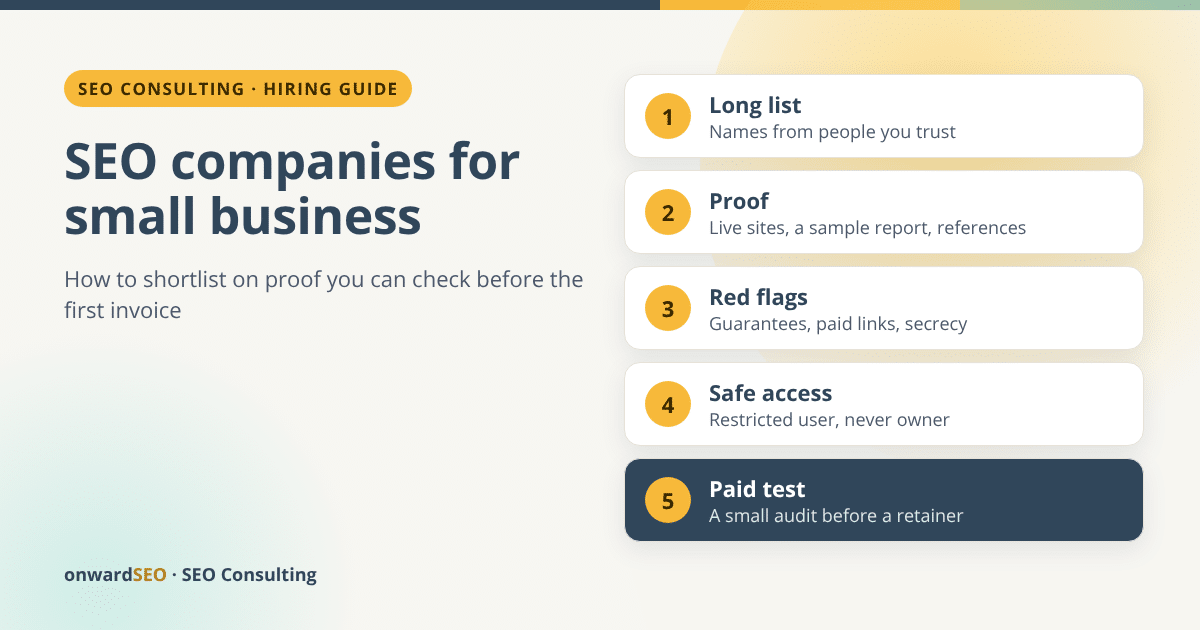
Below is a six-step shortlist method. It works for a large agency, a small studio or a solo consultant like me.
Why seo companies for small business look the same on paper
Visit ten SEO agency websites and you will read the same words: data-driven, transparent, tailored, results. None of that can be tested from a homepage. The differences that matter sit in places a website does not show: who actually does the work, how they report, what they change on your site and what happens when you want to leave.
Google has published its own advice on this. Its page Do you need an SEO? suggests asking an SEO for examples of previous work, what results they expect and in what timeframe, how they measure success, and whether they will share every change they make to your site. Those questions are the backbone of the method below. If you want the wider picture of what a good SEO can and cannot promise, I covered it in what Google itself says an SEO can and can’t do.

Step 1: Build a long list from evidence, not from ads
Start with five to eight names. Good places to find them are people you trust: your accountant, your web developer, a business owner in a similar market. Industry groups and conference speakers are also worth a look, because their work is public.
Two sources deserve caution:
- Cold emails. Google’s guidance says to be wary of SEO firms and web consultants that email you out of the blue. An email that says “I noticed your site is not ranking” is a sales template, not an audit.
- Review platforms. Reviews help, but they are only as honest as the people writing them. In the US, the FTC announced a final rule banning fake reviews and testimonials in August 2024, which covers creating or selling fake reviews and buying reviews with incentives. Treat a perfect score with no detail as a reason to ask more questions.
Step 2: Ask for proof you can verify yourself
This is the step most people skip, and it does most of the work. Send every company on your long list the same short email asking for the items in the table. A good company answers without fuss. A weak one sends a brochure.
| What they claim | What to ask for | How you check it |
|---|---|---|
| “We get results for businesses like yours” | Two live websites they worked on, with what they changed | Open the sites and search for the topics they name, on desktop and mobile |
| “We report every month” | A sample report, anonymised if needed | Does it show what was done and what to do next, or only charts? |
| “Our clients love us” | Two references you can call | Ask the references whether the SEO provided useful service, as Google suggests |
| “We fix technical issues” | A short description of how they would audit your site | Look for named checks (crawling, indexing, site structure), not buzzwords |
| “We build links” | How they get links and from where | Any answer that involves paying for links is a reason to stop |
A sample report tells you more than any sales call. If you have never read one, my walkthrough of how to read a rank tracking report shows what a useful one contains.
When a company says it ranks well for certain keywords, check that claim independently. Your own search is personalised by location and history, so it is not a fair test.
Step 3: Red flags that end the conversation
Some answers should remove a company on the spot, however friendly the call was. Google’s own page is clear on several of them: no one can guarantee a #1 ranking on Google, you should never have to link to an SEO, and you should be careful if a company is secretive or will not clearly explain what it intends to do.
Link schemes deserve special attention because the damage lands on your site, not the agency’s. Google’s spam policies list buying or selling links for ranking purposes, excessive link exchanges and using automated programs or services to create links as link spam. The same page says sites that violate the policies may rank lower in results or not appear in results at all. If you already suspect an earlier agency bought links for you, an SEO links audit is the place to start.
Stop the conversation if you hear any of these
- “We guarantee first page” or “We guarantee position 1”.
- “Our method is proprietary, we can’t tell you what we change.”
- “We will add a link to our agency in your footer.”
- “We submit your site to thousands of search engines.”
- “Sign for twelve months and you will see results.”
- “We need to be the owner of your Google accounts.”
A good SEO explains every change before making it. A bad one asks you to trust the method.
Step 4: Give access the safe way
Sooner or later an SEO will need to see your data. How you grant access is itself a test of the company. Google Search Console has clear permission levels, explained on its help page on managing owners, users and permissions:
- Owners have full control over a property, including adding and removing other users.
- Full users can view all data and take some actions.
- Restricted users have simple view rights on most data.
For a shortlisted company that is preparing a proposal, restricted user access is usually enough. Once they start work, full user access normally covers what they need. Ownership should stay with you. The same help page warns that removing an owner does not delete or revoke their verification tokens, so a removed owner could regain access while a token remains. That is a good reason never to let an agency verify your property with its own token in the first place.

Apply the same rule to analytics, hosting and your website admin: a named account for the SEO, never your own password, and a list of accounts to close if the work ends.
Step 5: Run a small paid test before a retainer
The best way to compare two good candidates is to pay each of them for something small and finished. An audit of one section of your site, a technical review of your top pages or a few hours of consulting all work. You learn how they think, how they write and whether they deliver on time.
What to look for in the test:
- Specific findings. “Page speed could be better” is not a finding. “These six templates load the same script twice” is.
- Priorities. A useful audit tells you what to fix first and why, and what can wait.
- Clarity. You, or your developer, should be able to act on it without another call.
- Honesty about scope. A good SEO will tell you when something is not worth paying for.
If you want a starting point for a test project, a website SEO audit is the most common one I do for small businesses. It produces a document you keep, whoever you hire next.
Step 6: Compare quotes on what you get, not on the price
Once two or three companies are left, you will get quotes in different shapes. Put them side by side by pricing model first, then by what each one actually delivers.
| Pricing model | Works well when | Watch out for |
|---|---|---|
| Hourly | You need expert help in bursts: an audit, a migration, a second opinion | Agree a cap on hours and a written summary of what was done |
| Monthly retainer | There is steady work every month: content, technical fixes, reporting | Ask what happens in a month with nothing urgent to do |
| Fixed project | The scope is clear, such as an audit or a site structure review | Check exactly what is and is not included |
| Performance based | Rarely a good fit for SEO | Ask how “performance” is measured and who controls it |
For the record, I charge by the hour and have no fixed packages, as stated on my profile page. That suits businesses that need senior help for a few days. A retainer can be the better choice when there is a lot of content to produce every month.
Whatever the model, tie the budget to what the work could be worth.
How to score your shortlist
Put every remaining company through the same gates. A company must pass all the “must pass” lines to stay. Only then compare the rest.
Shortlist scorecard
- Must pass: no guaranteed rankings, no paid links, no request for ownership of your accounts.
- Must pass: live examples you could check, and references who answered your call.
- Must pass: a sample report that shows actions, not only charts.
- Compare: how clearly the paid test explained what to fix first.
- Compare: who will do the work, and whether you can speak to that person.
- Compare: notice period and what you keep if you leave (reports, audits, accounts).

The last line matters more than people expect: your reports, audits and accounts are yours. Write that into the agreement.
Where onwardSEO fits, and where it doesn’t
I am not the right choice for every small business. If you need someone to write four blog posts a week for the next two years, a content team will serve you better. Where I am useful is when a small business needs an experienced person to look at the site, find what is holding it back and explain it in plain words: technical SEO, site structure, link audits, migrations and a second opinion on another agency’s plan. Use the same tests on me as on anyone else: ask for examples, ask how I report, and give me restricted access first. You can also read why businesses work with onwardSEO.
FAQ
How do I choose an SEO agency for small business?
Build a long list from people you trust, ask every company for the same proof (live examples, a sample report and references), then remove anyone who guarantees rankings or wants to buy links. Pay the last two or three for a small test project and choose the one whose work you understood best.
What are the best SEO services for small business to start with?
For most small businesses, a website audit is the best first service, because it shows what is holding the site back and gives you a document you keep. Technical fixes and the structure of your main service pages usually come next, with ongoing content and links once the basics are sound.
Should a small business sign a long SEO contract?
Not at the start. A short trial or a fixed project lets you judge the work before you commit. If you do sign a longer agreement later, make sure it has a notice period and states that reports, audits and accounts belong to you.
Is it a bad sign if an SEO company emails me first?
Not always, but Google’s own guidance says to be wary of SEO firms that email you out of the blue. Treat the email as an advert and apply the same checks you would to any other company on your list.
If you have a shortlist and want a second opinion on the proposals, or want me on it, tell me what you are comparing and I will give you an honest view.
Eugen Platon · SEO consultant with 16+ years in SEO and digital marketing · free 10-minute first call

Eugen Platon
Latest posts by Eugen Platon (see all)
- AI Overview Tracking: What ‘Cited #2 of 7’ Tells You About Your Traffic - October 19, 2026
- onwardSEO vs SERPRobot: When a SERPRobot Alternative Makes Sense (and When It Doesn’t) - October 19, 2026
- How to Check Keyword Rankings Accurately: 4 Methods and Where Each One Breaks - October 19, 2026
- SEO Companies for Small Business: How to Shortlist Without Getting Burned - October 18, 2026