
Key takeaways
- AI Overview tracking puts every keyword row in one of four states: no AI Overview, an AI Overview that skips your site, your site mentioned, or your site cited.
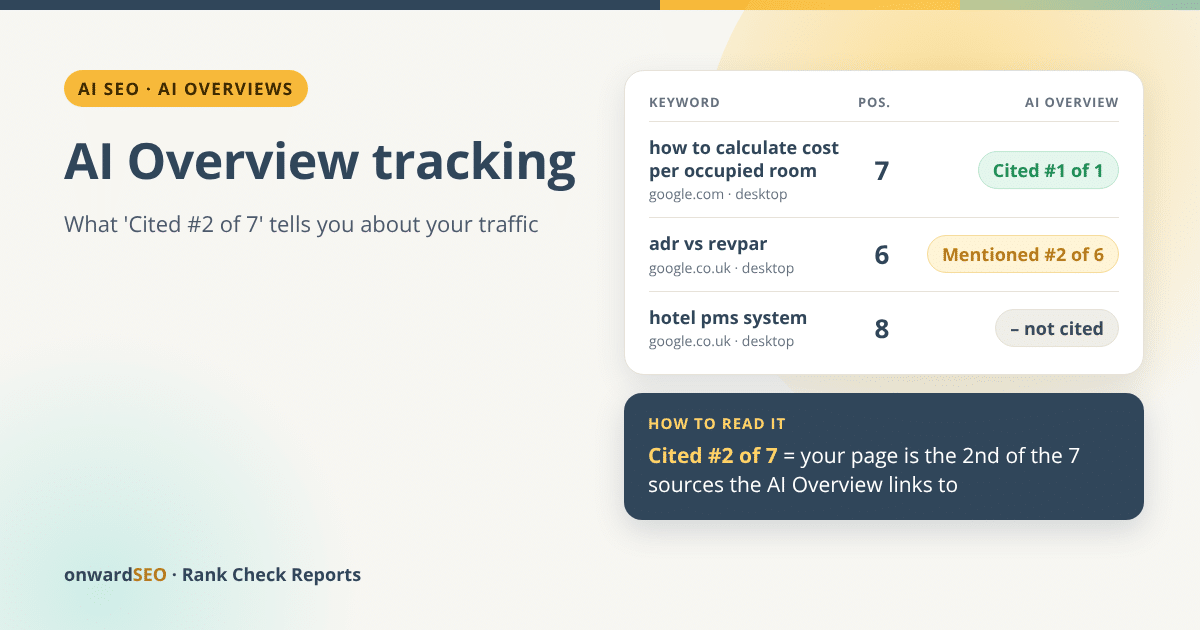
- “Cited #2 of 7” means a page of yours is the second of seven sources the AI Overview links to. The lower the first number, the earlier your link appears.
- Citation and organic position are separate results. In our public sample, a page in position 7 was the only source an AI Overview cited, and on a keyword where the site was outside the top 30, the AI Overview still mentioned it.
- The same keyword can be cited on google.com and only mentioned on google.co.uk, so track AI Overviews per Google edition and device.
- Keywords where an AI Overview appears and skips you are your content shortlist. Google says a page needs only to be indexed and eligible to show a snippet to qualify as a supporting link.
AI Overview tracking answers a question that a ranking position can’t: when Google puts an AI-written answer on the results page, does that answer point people to your site? A keyword in position 3 with no citation and a keyword in position 7 that is the only source cited tell two very different stories about where your clicks come from. A rank checker that tracks AI Overview citations records both, for every keyword on every engine you check.
Our Rank Check Reports record this for every keyword on every Google engine checked, in a column that reads “Cited #2 of 7”, “Mentioned” or a dash. This article explains how to read that column, using real rows from our public sample report: an anonymised hotel-software company, 100 keywords on four Google engines, checked on 12 September 2026.
What AI Overview tracking records for each keyword
Google describes AI Overviews as a way to help people “get to the gist” of a topic more quickly, and its guide to AI features and your website says AI features surface relevant links to pages on the web. An AI Overview does not appear on every search, so the first job of tracking is simply to record whether one was there.

For each keyword row, the report shows one of four states:
| What the column shows | What it means | Example from the sample |
|---|---|---|
| Blank | No AI Overview on that results page | “how to calculate cost per occupied room” on google.co.uk |
| A dash | An AI Overview appeared, your site is not in it | “hotel pms system”, position 8 on google.co.uk desktop |
| Mentioned #n of m | Your site is referred to, but not as a cited source link | “adr vs revpar”, position 6 on google.co.uk desktop: Mentioned #2 of 6 |
| Cited #n of m | A page of yours is one of the AI Overview’s linked sources | “how to calculate cost per occupied room”, position 7 on google.com desktop: Cited #1 of 1 |
Each row is one keyword on one engine, read from the same results page as the position, so the same keyword can land in a different state on each engine.
Cited, mentioned or absent: what each state means for your traffic
Cited is the strongest state. The AI answer on the page links to your page, so anyone who reads the answer has a direct route to you, whatever your organic position. Google’s Search Console help on impressions, position and clicks confirms that a click on a link to an external page in an AI Overview counts as a click, like any other.
Mentioned is weaker. Your site is part of the answer, but not one of the cited links, so your name may be seen while the route to your page is less direct. Treat a mention as a candidate to turn into a citation.
Absent (the dash) is the state to act on. The page shows an AI answer, and that answer sends people elsewhere. Your organic position may look healthy, but it now competes with an answer that doesn’t include you.
Blank means there was no AI Overview on that results page at the time of the check. Your position works the way it always has.
A position tells you where you are in the list. A citation tells you whether you are in the answer.
How to read “Cited #2 of 7”
The two numbers work like a position inside the AI Overview:
- The first number is your place in the list of sources. #1 means your link comes first. Read it like an organic position: lower is better, because your link is listed earlier.
- The second number is how many sources the AI Overview shows. “#1 of 1” means the answer rests on your page alone. “#4 of 11” means you are one of eleven, which is still a citation but a crowded one.
So “Cited #2 of 7” reads: an AI Overview appeared, it linked to seven sources, and yours was second. On a repeat check, watch both numbers. Moving from #5 of 7 to #2 of 7 is progress even if your organic position didn’t change.
Search Console can’t show you this. Google’s help page says an AI Overview occupies a single position in search results and that all links in it are assigned that same position. Your clicks from AI Overviews are counted, but your place among the sources is not visible there.
Why an AI Overview pushes your organic result down
Search Console counts the AI Overview as one position of its own. When it appears above the organic results, every organic listing moves further down the screen, and the first organic result is no longer the first thing a searcher reads.
That is why a position number alone can overstate your exposure on these pages. Look at the US desktop rows in figure 2: “hotel pms system” ranks 6th, on a page that also carries images, videos, People also ask and an AI Overview that does not cite the site. Position 6 on that page is not the same as position 6 on a page of plain links. We cover the other result types that change what a position is worth in SERP features tracking.

I won’t give you a click-through rate for any of these states: none of them is a fixed number. Measure the effect with your own data instead, comparing Search Console clicks for queries where you are cited with those where you are absent.
Citation is not the same as ranking: what the sample shows
In the sample, the AI Overview does not simply quote the top organic results:
- “how to calculate cost per occupied room” ranks 7th on google.com desktop and mobile, and on both it is the only source cited: Cited #1 of 1 (marker 1).
- “cost per occupied room formula” ranks 6th on the same two engines and is also Cited #1 of 1.
- “what is revpar in hotel” is not in the top 30 on either UK engine, yet the AI Overview mentions the site as #5 of 8.
- “par level in housekeeping” ranks 16th on google.com desktop, on page two, and the AI Overview still mentions the site as #4 of 11.
One keyword shows how much the engine matters:

“adr vs revpar” ranks between 5th and 6th everywhere, but the AI Overview tells a different story on each engine: mentioned #2 of 6 on both UK engines, cited #2 of 2 on google.com desktop, and no AI Overview at all on google.com mobile. This is one client’s sample, not a rule about how Google chooses sources, but it shows why AI Overviews need checking on every engine you report.
How to read “cited in n of m AI Overviews”
The report also adds the column up. “Cited in n of m AI Overviews” reads literally: of the m AI Overviews the check found, n cited your site. Mentions are counted separately. In the public sample the site is cited in 5 keyword rows and mentioned in 6.
Use the line in three ways:
- Track n over time. More citations on the same keyword list and engines is the clearest sign your content is being used.
- Treat the gap as a worklist. Every row with a dash or a mention is a results page with an AI answer that doesn’t cite you.
- Watch m as well. If more of your keywords start showing an AI Overview, a steady organic position may bring fewer visits, and the citation column becomes more important.
Keep the keyword list, the engines and the depth the same between checks, or the counts measure your setup rather than your progress.
What to do with keywords that show an AI Overview but don’t cite you
Google’s guidance is plain: to be shown as a supporting link, a page must be indexed and eligible to appear in Google Search with a snippet, and there are no additional requirements or special markup. So the work is about eligibility and content, not tricks.
When an AI Overview appears without your site
- Start with keywords where you already rank in the top 10. “hotel pms system” ranks 8th on google.co.uk desktop and 6th on google.com desktop, and isn’t cited on either.
- Check the ranking URL is indexed and can show a snippet: no noindex, and no nosnippet or tight max-snippet rule on that page.
- Open the results page from the same country and device, read the AI Overview and note which question it answers.
- Compare it with your page: is the direct answer near the top, in plain words, or buried under an introduction?
- Make sure the ranking URL is the page you would want cited, not a category page or an older article.
- Check again next month on the same engines and compare the column row by row.
The column also completes the routine in our guide on how to read a rank tracking report: positions, then bands, then the keywords where an AI answer skips you.
If you’d rather have someone read the report and turn it into actions every month, our SEO rank tracking service does exactly that. If you only need the data, you can get AI Overview citations with your next rank check: they are included in every report at no extra cost.
FAQ
How do I track AI Overviews for my keywords?
You can search each keyword by hand, but Google’s Performance report help notes that results are specific to the time, place, device and recent history of the person searching, and you can only check one keyword, country and device at a time. A rank report records, for every keyword and engine, whether an AI Overview appeared and whether it cited or mentioned your site, from the same results page as your position.
Does Google Search Console show AI Overview data?
Partly. Google’s guide says traffic from AI features is included in your overall search traffic and reported in the Performance report under the “Web” search type, so it is mixed in with your other results. And because all links in an AI Overview share one position, Search Console can’t show where you appeared among the sources.
What is the difference between cited and mentioned in an AI Overview?
Cited means a page of yours is one of the AI Overview’s linked sources, with your place in that list. Mentioned means your site is referred to in the answer without being one of the cited links. A citation gives searchers a direct route to your page, so it is the state to aim for.
Why am I cited on one Google edition but not another?
Each country edition and device returns its own results page, and the AI Overview on it can differ or be missing. In the sample, “adr vs revpar” is cited on google.com desktop, mentioned on both UK engines and has no AI Overview on google.com mobile.
Find out which of your keywords show an AI Overview and whether it cites you, on four Google engines, desktop and mobile, in one report.
From $14.99 per check · no subscription · report within one working day

Eugen Platon
Latest posts by Eugen Platon (see all)
- AI Overview Tracking: What ‘Cited #2 of 7’ Tells You About Your Traffic - October 19, 2026
- onwardSEO vs SERPRobot: When a SERPRobot Alternative Makes Sense (and When It Doesn’t) - October 19, 2026
- How to Check Keyword Rankings Accurately: 4 Methods and Where Each One Breaks - October 19, 2026
- SEO Companies for Small Business: How to Shortlist Without Getting Burned - October 18, 2026