
Key takeaways
- One freelancer often ends up holding every key to your site. Plan for that before the first invoice, not after the last one.
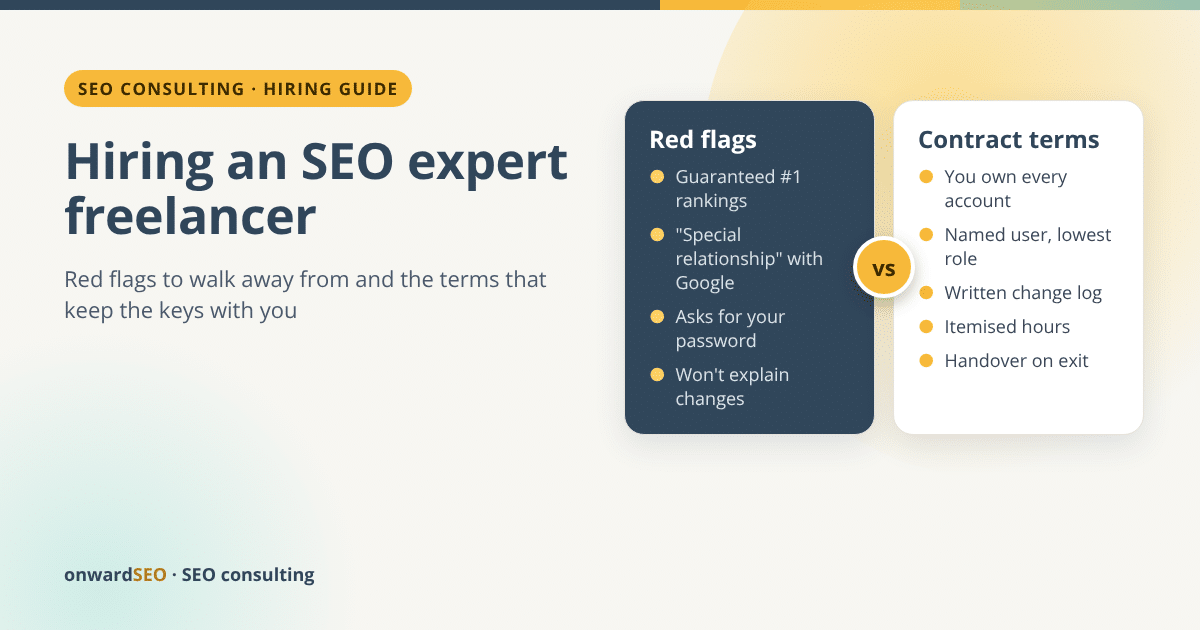
- Walk away from guaranteed rankings, a “special relationship” with Google, secret methods and cold emails promising page one.
- Give each tool the lowest role that does the job, under the freelancer’s own login. Never share your password.
- Put five things in writing: scope, a change log, who owns the work and the accounts, how billing works, and a handover on exit.
- Keep an exit checklist ready from day one, including removing Search Console verification tokens.
Hiring an SEO expert freelancer can be the best value in search marketing or the most expensive mistake you make this year, and the difference is usually decided before any work starts. A good freelancer gives you senior attention without agency overheads. The risk is that one person ends up with your CMS login, your hosting, your Search Console, your analytics and your Google Business Profile, and you only notice when they stop answering emails.
I have worked as a freelance SEO consultant and run onwardSEO for more than 16 years, so I have been on both sides of this: the person being hired, and the person called in afterwards to sort out what a previous contractor left behind. This article covers the red flags I would walk away from and the contract terms I would want in place if I were the client.
None of this is about distrust. Clear access rules and a written scope protect a good freelancer as much as they protect you.
Why one person holding the keys changes the risk
With an agency, someone else can pick up the work if one person leaves. With a freelancer, everything runs through one person. That is the attraction and the risk.
In clean-up projects, the problems I find are rarely dramatic. They are small and quietly expensive:
- The freelancer verified Search Console with their own token and is the only owner of the property.
- Analytics was set up in the freelancer’s own account, so the history goes with them.
- Nobody kept a list of what changed, so a ranking drop cannot be traced to a cause.
- Links were bought in the client’s name and nobody knows where.
Each is avoidable with an hour of setup at the start.
Red flags to spot before you hire an SEO expert freelancer
Google publishes its own advice for hiring help in Do you need an SEO? Its warnings match what I see in practice: Google says no one can guarantee a #1 ranking, and tells you to beware of SEOs that claim to guarantee rankings, allege a “special relationship” with Google or advertise a “priority submit” to Google. It also says to be careful if a company is secretive or won’t clearly explain what they intend to do, and to be wary of firms that email you out of the blue.
| What you hear | Why it is a problem | What to ask instead |
|---|---|---|
| “I guarantee you page one.” | Google says no one can guarantee a #1 ranking. | “What results do you expect, in what timeframe, and how will you measure them?” |
| “I have contacts at Google.” | Google warns against SEOs that claim a “special relationship”. | “Do you follow Google Search Essentials?” |
| “My methods are confidential.” | Google says to be careful with anyone who won’t explain what they intend to do. | “Will you share every change you make to my site, and why?” |
| “Give me your admin password.” | You lose any record of who did what. | “Which role do you need in each tool, under your own login?” |
| “I’ll build you hundreds of links.” | Google warns against link popularity schemes. | “Where would links come from, and can I approve each one?” |
| “I’ll set up analytics in my account.” | Your data history leaves with them. | “Can you set it up in an account I own and add you as a user?” |
Most of the useful questions come straight from Google’s page: ask for examples of previous work, whether they follow Search Essentials, what results to expect and when, their experience in your industry and country, and whether they will share all the changes they make with the reasoning behind them. For a fuller picture of what a real expert promises, I cover it in what Google itself says an SEO can and can’t do.
A freelancer who won’t explain a change to you is a freelancer you can’t safely replace.
Access: give each tool the right role, not your password
Google’s page says that at the interview stage you should only grant read access to Search Console and not write access. I agree, and I would go further: even after you hire, give each tool the lowest role that covers the work, always under the freelancer’s own Google account or user login. Shared passwords leave no record of who changed what, and they are hard to take back.
The main Google tools all separate owners from users:
- Search Console. Google’s owners, users and permissions help page lists owners (who have full control and can add and remove other users), full users (view rights to all data and some actions) and restricted users (simple view rights on most data). A property must have at least one verified owner. That verified owner should be you.
- Google Analytics. The GA4 access management page lists Administrator, Editor, Marketer, Analyst and Viewer roles. Only an Administrator can manage users. An Editor has full control of settings at the property level but can’t manage users, which suits most freelance work.
- Google Business Profile. According to Google’s owners and managers help page, a profile can have several owners but only one primary owner, and managers can’t add or remove users or remove the profile. Keep primary ownership yourself and add the freelancer as a manager.
- CMS and hosting. Create a named user for the freelancer. On WordPress, a separate administrator account per person at least means you can remove one person without changing everyone’s password. For FTP or server access, Google’s page says the SEO should be willing to explain all the changes they make.

The contract terms that protect both sides
You do not need a long contract, just a clear one. These are the terms I would want as a client, and the ones I sign myself.
Contract terms for hiring an SEO freelancer
- Scope and deliverables: what will be done, what will be delivered (an audit document, fixes, briefs, monthly notes) and what is out of scope.
- Change log: every change to the site, settings or tags is written down with a date, a page and a reason.
- Ownership: all accounts, properties, data, content and reports belong to the business; the freelancer works as a user.
- Methods: work follows Google Search Essentials; no paid links or private networks without written approval.
- Billing: hourly rate or fixed fee per deliverable, an hours cap per month, and an itemised timesheet with each invoice.
- Reporting: what you get each month and which numbers it shows, agreed before the first month.
- Subcontracting: whether anyone else will touch the site, and only with your approval.
- Notice and handover: a notice period and a handover list (log, files, logins removed, open tasks).
Two of these cause most disputes, so a little more on each.
Billing. I charge by the hour, with no fixed packages, because SEO work rarely fits a bundle. That model only works for the client if the hours are visible. Ask for a monthly cap you can raise by email, and a timesheet that says what each block of time produced. A retainer with no breakdown makes it hard to judge value at all.
Reporting. Agree what a monthly report contains before work starts: rankings for an agreed keyword list, organic traffic and conversions from your own analytics, and the work done. Our walkthrough of how to read a rank tracking report shows the sections I would ask for. The point is that the numbers come from tools you own, not from a screenshot the freelancer sends.
Affordable search engine optimization professional: what cheap really costs
There is nothing wrong with looking for an affordable search engine optimization professional. Plenty of small businesses need ten hours of focused work, not a monthly retainer. A freelancer is often the right answer precisely because you pay for the work and not for an office.
The problem is when low price is achieved by cutting the parts you cannot see: no change log, no explanation, bulk links from unknown sources, or content produced in volume with nobody checking it. Google’s page is blunt that if an SEO creates deceptive or misleading content on your behalf, your site could be removed entirely from Google’s index, and that you are responsible for the actions of anyone you hire.
A fair way to compare quotes is to ask each freelancer what they would do in the first month and what you would receive at the end of it. If one quote is half the price of the others, ask which work is missing. Sometimes it is a smaller scope; sometimes it is the part that protects you.
If you are not sure what your site needs, a scoped SEO website audit is a sensible first purchase from any freelancer: it gives you a written list of issues you keep, whoever does the fixes.
The exit plan: offboarding a freelancer cleanly
Freelance work ends for ordinary reasons, so write the exit plan at the start, when everyone is on good terms.

The step most people miss is in Search Console. Google’s help page says that to add or remove a verified owner, you must add or remove a token on the site, and warns that if you do not delete these tokens, the removed owner will be able to re-verify ownership. Check for verification files, meta tags and DNS records they may have added.
For Google Business Profile, plan ahead: Google says new owners or managers must wait 7 days before they can transfer primary ownership, and a primary owner cannot remove themselves until ownership is transferred. If a freelancer ended up as primary owner, sort that out while they are still responsive.
After the handover, open the pages they changed last and check they still work as intended.
When a freelancer is the right choice, and when it isn’t
Expert search engine optimization services do not require an agency. A freelancer is usually the better fit when:
- the work is specialist (a technical audit, a migration, a penalty review) and you want the person who does it on the call;
- you have someone in-house who can make changes and needs direction;
- the budget suits a defined number of hours rather than a monthly retainer.
An agency or a small team can suit you better when you need several disciplines every week (content production, development and digital PR at once), or when you cannot accept any gap if one person is ill or on holiday. Our page on working with SEO consultants explains how I structure consulting work.
My own approach follows the terms above: you own every account, I work as a named user, I log what I change, and I bill by the hour with the time itemised. You can read about my background and certifications on my profile page.
FAQ
How do I find an affordable search engine optimization professional I can trust?
Ask each candidate Google’s questions: examples of previous work, whether they follow Search Essentials, what results they expect and when, and whether they will share every change. Compare what each would deliver in the first month, not only the price.
Should an SEO expert freelancer have admin access to my website?
Only if the work needs it, and only under their own named login. Many tasks can be done with editor-level CMS access and a full user role in Search Console. Keep ownership of every account yourself, so you can remove one person without disrupting anyone else.
What should a contract for expert search engine optimization services include?
At minimum: scope and deliverables, a change log, a clause that all accounts and data belong to you, a commitment to follow Google Search Essentials, how billing and timesheets work, and a notice and handover period. Sign it before access is granted.
Can a freelancer guarantee first-page rankings?
No. Google states that no one can guarantee a #1 ranking on Google, and its hiring advice tells you to find someone else if an SEO promises first place.
If you are about to hire an SEO freelancer and want a second opinion on the scope or the contract, let's talk it through.
Eugen Platon · SEO consultant with 16+ years in SEO and digital marketing · free 10-minute first call

Eugen Platon
Latest posts by Eugen Platon (see all)
- SEO Experts Near Me: Why the Closest Agency Isn’t Always the Right One - October 19, 2026
- Hiring an SEO Expert Freelancer: Red Flags and Contract Terms - October 19, 2026
- AI Overview Tracking: What ‘Cited #2 of 7’ Tells You About Your Traffic - October 19, 2026
- onwardSEO vs SERPRobot: When a SERPRobot Alternative Makes Sense (and When It Doesn’t) - October 19, 2026