
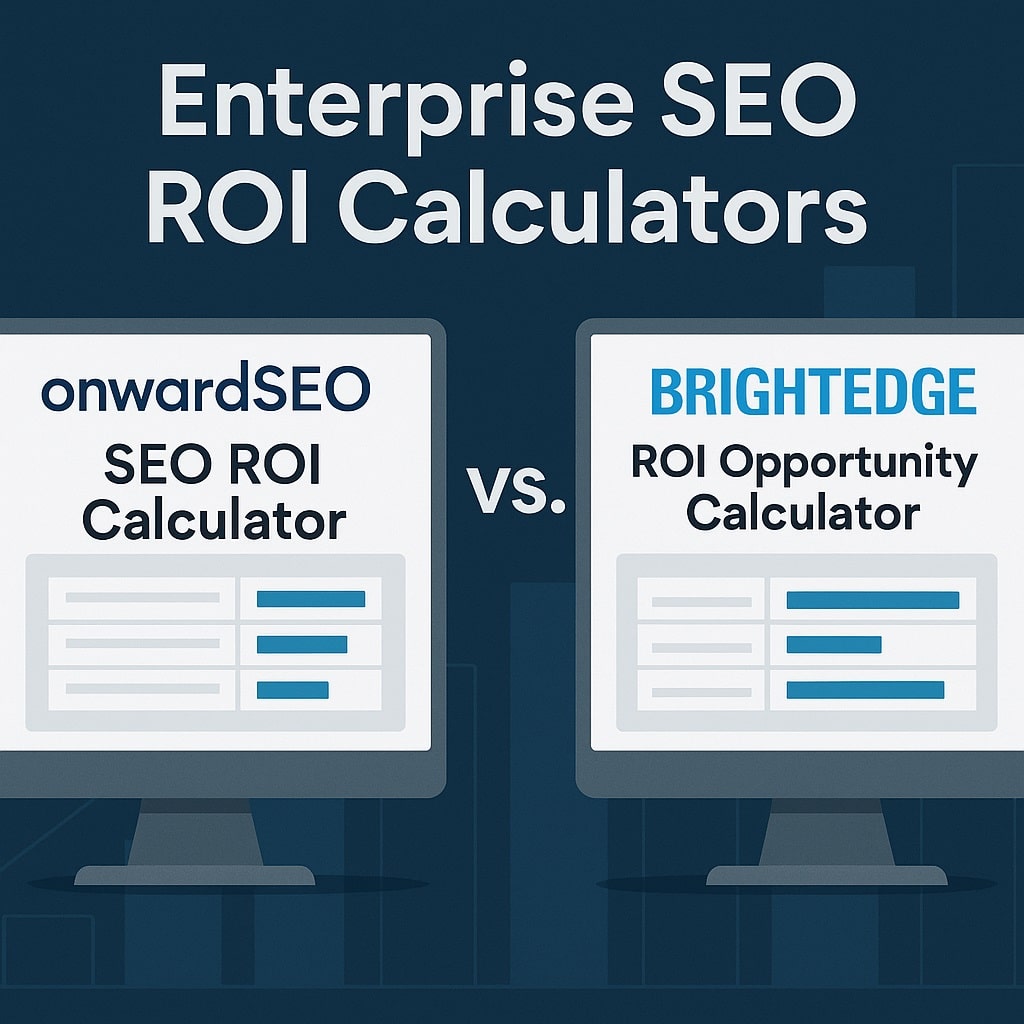
Measuring the return on SEO is no longer a “nice to have” for enterprise teams—it’s how budgets get approved, how initiatives are prioritized, and how strategy earns a seat in the boardroom. But not all ROI calculators are built for the same job. In this in-depth review, I compare onwardSEO’s SEO ROI Calculator with BrightEdge’s Organic Search ROI Opportunity Calculator, dissecting inputs, assumptions, outputs, workflow fit, and enterprise usability. I’ll also run through example scenarios, list real-world pros and cons, and close with a documented conclusion on where each tool shines—and why onwardSEO’s calculator offers a decisive edge for day-to-day strategy and prioritization.
The Calculators at a Glance
BrightEdge: Organic Search ROI Opportunity Calculator
BrightEdge provides a form-gated SEO calculator that invites you to plug monthly data (e.g., current US non-brand organic search traffic, query volume, average organic CTR, conversion rate, profit per conversion) and a CTR gain per 2-position improvement to estimate incremental traffic, conversions, and profit opportunity. The tool is positioned as a way to show “how much more you could make” from ranking improvements, and BrightEdge frames it as part of a broader platform story around forecasting and executive business cases.
What it’s best at:
a high-level “what if we move up the SERP?” view that outputs incremental traffic/conversions/revenue for business-case conversations.
onwardSEO: SEO ROI Calculator
onwardSEO international SEO agency offers a free, web-based calculator with a tactical focus on keyword-level ROI. You feed it keyword, search volume, CPC, and current rank for up to a set of keywords; add monthly SEO cost, conversion rate, and revenue per conversion; and it produces traffic and revenue projections by ranking bracket (e.g., Top 1–3, 4–6, etc.), as well as estimated conversions, total revenue, and monthly ROI. It relies on industry-standard CTR curves by rank bracket exposed in the UI. onwardSEO
What it’s best at:
prioritizing which keywords are worth the effort right now, quantifying payoffs by rank tier, and helping SEO teams direct resources to the highest-yield opportunities.
How Each Calculator Thinks About ROI
Modeling Mindset
BrightEdge models incremental lift from ranking movement. You supply your baseline (traffic, CTR, conversion rate, profit per conversion), and the calculator projects incremental traffic, conversions, and profit tied to assumed CTR gains from moving up two positions (or multiples thereof). It’s purposely simple and business-facing—good for executives and budget holders who want the upside story if rankings improve. brightedge.com
onwardSEO models ROI at the keyword ledger level. It maps each keyword’s rank bracket to a CTR estimate, multiplies CTR by search volume to estimate traffic, then pushes that through your sitewide (or campaign-level) conversion rate and revenue per conversion. If you add monthly SEO cost, you’ll get Monthly ROI and Net ROI to guide tactical investment. This micro-to-macro approach is ideal for prioritization—you see exactly which keywords justify spend or content work. onwardSEO
Inputs Compared (and Why They Matter)
BrightEdge Inputs (Monthly)
- Current US non-brand organic traffic
- US non-brand query volume
- Avg organic CTR (%)
- Conversion rate (%)
- Profit per conversion ($)
- Expected CTR gain per 2-position improvement on page 1
These produce increased traffic, conversions, and monthly profit opportunity. brightedge.com
Implication: you need to know (or assume) how CTR changes as you move up the SERP. This is powerful but somewhat coarse: it’s easy to communicate, yet it abstracts away keyword-level variability (mixed intents, different SERP layouts, branded influence, etc.).
onwardSEO Inputs (Per Keyword + Monthly)
- Keyword, search volume, CPC, current rank
- Monthly SEO cost, conversion rate, revenue per conversion
Using rank-tier CTR estimates, the calculator projects traffic, conversions, revenue, and monthly / net ROI. onwardSEO
Implication: you get granular control. Because each keyword can carry different economics (volumes, CPC proxies for value, realistic rank targets), you can stack-rank opportunities instead of relying on a single broad assumption.
Outputs Compared
BrightEdge: What You Get
- Increased traffic
- Increased conversions
- Monthly profit opportunity (often framed as additional profit if rankings improve to a specified degree)
These outputs work wonderfully in executive narratives—”If we move up two positions, we can capture X more profit per month.” It’s quick and persuasive. brightedge.com
onwardSEO: What You Get
- Estimated traffic per keyword (by rank bracket)
- Estimated conversions and revenue
- Monthly SEO ROI and Net SEO ROI
This output answers resource allocation questions: “Which 10 keywords give me the most ROI if I push them into Top 4–6 vs. Top 1–3?” It’s immediately actionable for roadmaps (content, links, technical tickets). onwardSEO onwardseo SEO ROI calculator
Where the Data Comes From
BrightEdge suggests using Google Search Console (formerly GWT) data to populate the sheet. Many enterprise teams already centralize GSC exports, so this encourages adoption. brightedge.com
onwardSEO leans on CTR curves by rank tier and your supplied search volume, CPC, rank, conversion, and revenue inputs. This structure mirrors common SEO forecasting practice (volume × CTR × CVR × AOV) and exposes the CTR assumption explicitly so you can sanity-check it. onwardSEO
Scenario Walk-Throughs (Illustrative)
The calculations below use the fields these tools request and standard math. Numbers are illustrative to show how decisions change under each model.
BrightEdge-Style Scenario (Incremental Lift)
- Current US non-brand organic traffic: 5,750 / mo
- US non-brand query volume: 167,300
- Avg organic CTR: 3.4%
- Conversion rate: 1.5%
- Profit per conversion: $90
- Expected CTR gain per +2 positions: 3.5%
(Values mirror the example structure BrightEdge shows.) brightedge.com
What it implies:
- Increased traffic is driven by the incremental CTR uplift applied to the relevant query volume.
- Increased conversions = increased traffic × CVR.
- Monthly profit opportunity = increased conversions × profit per conversion.
That last line is what executives want to see: a monthly dollar figure tied to a specific ranking improvement.
onwardSEO-Style Scenario (Keyword Set Prioritization)
Imagine three target keywords with different economics:
- “enterprise seo platform” – Vol 3,200; CPC $28; Current rank 12
- “seo roi calculator” – Vol 8,100; CPC $12; Current rank 22
- “brightedge alternatives” – Vol 1,000; CPC $18; Current rank 9
Assume:
- Conversion rate: 2.0%
- Revenue per conversion: $300
- Monthly SEO cost allocated to this cluster: $7,500
onwardSEO CTR table (rank-tier): the tool exposes CTR ranges for tiers like Top 1–3, 4–6, 7–10, 11–15, 16–20, etc. (We’ll use the tool’s displayed CTR tiers conceptually here.) onwardseo seo roi calculator
Now compare target outcomes:
- If “enterprise seo platform” moves from 11–15 to 4–6, you apply the CTR for those tiers to 3,200 volume, push through 2% CVR and $300 value, and compute expected revenue.
- Repeat for the other two keywords at realistic target tiers (e.g., “seo roi calculator” from rank 22 to 7–10; “brightedge alternatives” from rank 9 to 4–6).
- Sum all three. Compare to $7,500 monthly cost to see Monthly ROI and Net ROI.
What it implies: you immediately see which keyword jumps matter. If the blended ROI clears internal hurdles (say, > 200–300% for enterprise), you green-light the sprint.
Strengths & Trade-offs
BrightEdge ROI Opportunity Calculator — Pros
- Executive-friendly framing. Incremental profit stories are easy to present in QBRs and budget cycles. brightedge.com
- Simple data workflow. Pull a handful of monthly fields from GSC/analytics, and you’re ready.
- Platform alignment. Pairs with BrightEdge’s broader Opportunity Forecasting narrative and suites for prioritization/roadmapping. brightedge.com
BrightEdge ROI Opportunity Calculator — Cons
- Coarse granularity. It summarizes change across a set of queries; individual keyword outliers (e.g., wildly different SERP layouts or intents) are obscured.
- CTR gain assumption risk. A uniform “CTR gain per +2 positions” can diverge from reality when features like Top Stories, video packs, or brand bias dominate a SERP.
- Form-gated access. If you need a quick, shareable spreadsheet for cross-team use, the gate adds friction. brightedge.com
onwardSEO SEO ROI Calculator — Pros
- Granular, keyword-level economics. Lets you compare opportunities side-by-side and invest where ROI is provably highest. onwardSEO
- Transparent CTR tiers. The rank-tier table (Top 1–3, 4–6, etc.) is visible in the tool, which keeps assumptions explicit and tweakable.
- Budget-ready outputs. Monthly ROI and Net ROI make it easy to justify resourcing (content, links, engineering) around the keywords that pay.
- Free and fast. No gate, no subscription—immediate tactical analysis for teams of any size. onwardSEO
onwardSEO SEO ROI Calculator — Cons
- Focused scope. It does not attempt full lifetime value or discounted cash flow modeling; you’ll still communicate those using finance frameworks elsewhere.
- Input hygiene matters. Garbage-in, garbage-out: if your conversion rate or revenue per conversion are off, you’ll mis-rank opportunities.
- Tier CTR ≠ one-size-fits-all. As with any CTR curve, SERP composition can shift real click behavior. The benefit is you can see and adjust assumptions directly.
Workflow Fit for Enterprise SEO
When You’re Building a Business Case
Use BrightEdge to quantify upside from rank gains and speak in monthly profit opportunity—a board-ready story. The Opportunity Forecasting context complements the basic calculator with fuller platform-level capabilities for prioritization and outcome modeling. brightedge.com
When You’re Planning Sprints and Priorities
Use onwardSEO to sort the backlog: Which keywords justify content refresh vs. net-new content vs. link acquisition vs. technical tickets? It’s designed for weekly prioritization meetings and sprint planning based on actual expected ROI at the keyword level. onwardSEO
Pragmatic best practice:
many enterprise teams succeed by pairing the two modes—onwardSEO for daily/weekly prioritization, finance-style models (internal or BrightEdge-framed) for quarterly investment cases.
Accuracy, Assumptions & Risk
CTR Assumptions
BrightEdge: uses a fixed CTR-gain per +2 positions. This is elegantly simple but potentially over-general when SERP features change click distributions. brightedge.com
onwardSEO: uses a rank-tier CTR table that you can visually inspect. If your industry leans informational or your SERPs are heavy with aggregators, you can temper expectations by targeting a lower tier first, compare ROI, and iterate.
Conversion & Revenue Inputs
Both calculators rely on accurate CVR and revenue per conversion (or profit per conversion for BrightEdge). The difference is how you’ll use the outputs: onwardSEO’s list view helps you de-risk by spreading bets across multiple high-ROI keywords, while BrightEdge’s view helps align leadership on the upside case.
Usability & Adoption
BrightEdge: the calculator is form-gated, and its language targets executive stakeholders first. If the goal is to secure buy-in, that’s useful; for daily keyword ops, teams will likely work inside the BrightEdge platform proper or export to their internal sheets. brightedge.com
onwardSEO: immediate, browser-based, and free. Because it’s quick to use, analysts, content strategists, and SEOs are more likely to run it weekly and keep ROI-based prioritization alive in sprint rituals. onwardSEO
Example Enterprise Playbook (Using Both)
Quarterly: Build the strategic narrative.
Run BrightEdge’s ROI Opportunity framing with conservative CTR-gain assumptions and finance-friendly profit figures. This earns or protects the budget.
Monthly: Refresh the keyword portfolio.
Use onwardSEO to evaluate 10–20 keywords per theme, comparing realistic target tiers (e.g., Top 7–10 vs. Top 4–6). Fund the top quartile by expected ROI. onwardSEO
Sprint: Execute the highest-ROI moves.
Assign content refreshes, internal link updates, technical improvements, and link acquisition to the top ROI keywords. Re-run upward movement and track realized ROI.
QBR: Close the loop.
Show how keyword-level wins rolled up into the profit-opportunity narrative executives care about.
Expanded Feature-by-Feature Comparison
| Feature | BrightEdge | onwardSEO |
|---|---|---|
| 1) Focus and Granularity | Macro, monthly profit opportunity anchored to ranking position improvements. Executive clarity. brightedge.com | Micro, keyword-level ROI with rank-tier transparency and cost accounting for monthly ROI decisions. onwardSEO |
| 2) Input Burden | Few inputs; easier to socialize; GSC sourcing reduces friction. brightedge.com | More granular inputs (per keyword), but that’s precisely what fuels actionable prioritization. onwardSEO |
| 3) Output Relevance by Role | CMO/CFO buy-in, annual planning, and top-down funding. brightedge.com | SEO managers, analysts, editors—anyone choosing what to work on this sprint. onwardSEO |
| 4) Forecasting Philosophy | “If we move up, what is the profit upside?” Easy to grok, potentially aggressive if the CTR-gain assumption is optimistic. brightedge.com | “Which keywords give the best ROI at realistic target tiers?” Conservative by design: you can model incremental steps (e.g., rank 18 → 11–15 first), sanity-check, and iterate. |
| 5) Access & Speed | Form gate and platform tie-ins. Great for formal processes. brightedge.com | Open access and fast feedback for everyday decision-making. onwardSEO |
FAQ (Before Final Thoughts)
Q1: Can I use onwardSEO’s ROI calculator to build a board-level business case?
A: Yes—with a caveat. onwardSEO excels at prioritization and ROI clarity per keyword. For board-level decks, aggregate those keyword-level projections and present them as a program forecast. If your finance team expects LTV or discounted cash flows, complement onwardSEO outputs with internal finance models or a BrightEdge-style opportunity narrative. onwardSEO
Q2: Does BrightEdge’s calculator replace detailed keyword planning?
A: No. It’s superb for high-level profit opportunity framing but won’t tell you which specific keywords produce the best ROI this sprint. Pair it with a keyword-level tool (like onwardSEO) for granular prioritization. brightedge.com
Q3: Which tool is better for weekly workflows?
A: onwardSEO. It’s open, fast, and designed for hands-on keyword ranking scenarios and monthly ROI tracking. BrightEdge’s calculator is better suited to quarterly or annual buy-in cycles. onwardSEO
Q4: How sensitive are the results to CTR assumptions?
A: Very. In BrightEdge’s model, the CTR gain per +2 positions drives most of the upside. In onwardSEO, the rank-tier CTR table is explicit; you can downshift to a more conservative tier and re-run ROI instantly. Always sanity-check CTR against your vertical’s SERP features. brightedge.com
Q5: Where should my conversion rate and revenue per conversion come from?
A: Pull them from analytics/CRM: conversion rate from your landing pages or organic channel performance; revenue per conversion from closed-won data or average order value. Both calculators are only as accurate as these inputs.
Q6: How do I incorporate cost of content, technical work, and links?
A: onwardSEO includes a monthly SEO cost field, so you can factor in agency fees, writers, design, links, and platform tools. For BrightEdge’s calculator, you’ll typically compare the incremental monthly profit opportunity to your program cost in a separate model or slide. onwardSEO
Q7: We operate outside the US. Are these calculators still valid?
A: Yes. Replace “US non-brand” with your primary market in BrightEdge’s sheet; in onwardSEO, use your local search volumes and rank data. Keep in mind CTR can vary by market and SERP composition.
Q8: Can I model different content types or intents?
A: onwardSEO’s keyword-level approach lets you segment by intent (transactional, commercial, informational) and compare ROI across content types (product pages, hub pages, guides). In BrightEdge’s framing, you’d typically group queries by theme and run separate scenarios for each. onwardSEO brightedge.com
Q9: How often should I re-run these?
A: Weekly for onwardSEO (to keep the backlog sorted and sprints on the highest-ROI work), quarterly for BrightEdge-style opportunity narratives (to support budgets and show upside). onwardSEO
Q10: Does BrightEdge have more advanced forecasting beyond the simple calculator?
A: Yes. BrightEdge promotes Opportunity Forecasting capabilities in its platform for projecting traffic, conversions, and revenue impacts and for making stronger business cases—beyond the basic calculator. brightedge.com
Final Thoughts: Why onwardSEO’s Calculator Offers the Edge
Both calculators have real value, but they serve different masters:
BrightEdge’s Organic Search ROI Opportunity Calculator is the storyteller. In a few fields, you can articulate the profit upside of ranking improvements—a concise narrative executives understand immediately. It fits neatly into a broader platform built for forecasting and stakeholder alignment.
onwardSEO’s SEO ROI Calculator is the operator’s console. It lets SEO managers and analysts rank opportunities by tangible ROI, aligning content, links, and technical bandwidth to the keywords that matter most this month. You can dial in rank-tier expectations, see the math, and move the roadmap accordingly. For ongoing enterprise execution, that’s the edge. onwardSEO
My recommendation for enterprise teams:
Use onwardSEO as your weekly prioritization engine—the practical tool that turns budget into the highest possible return by keyword.
Use BrightEdge’s calculator (and platform forecasting) to package the upside for leadership and to keep long-range planning aligned with business outcomes.
When you combine onwardSEO’s tactical precision with BrightEdge’s executive narrative, SEO stops being a black box and becomes a repeatable investment machine—funded with confidence at the top and executed with accuracy at the edge.

Eugen Platon
Latest posts by Eugen Platon (see all)
- H Tags in SEO: What 17 Years of Evidence Taught Me About Heading Structure - July 21, 2026
- Pinger Tool v1.3.0 Is Here – Faster, Safer, and Built for Reliable Indexing Pings - December 19, 2025
- How to Calculate SEO ROI in 2025 – Step-by-Step Guide Plus Free SEO ROI Calculator - November 17, 2025
- Enterprise SEO ROI Calculator – Turn Thousands of Keywords Into a CFO-Ready Business Case - November 15, 2025