
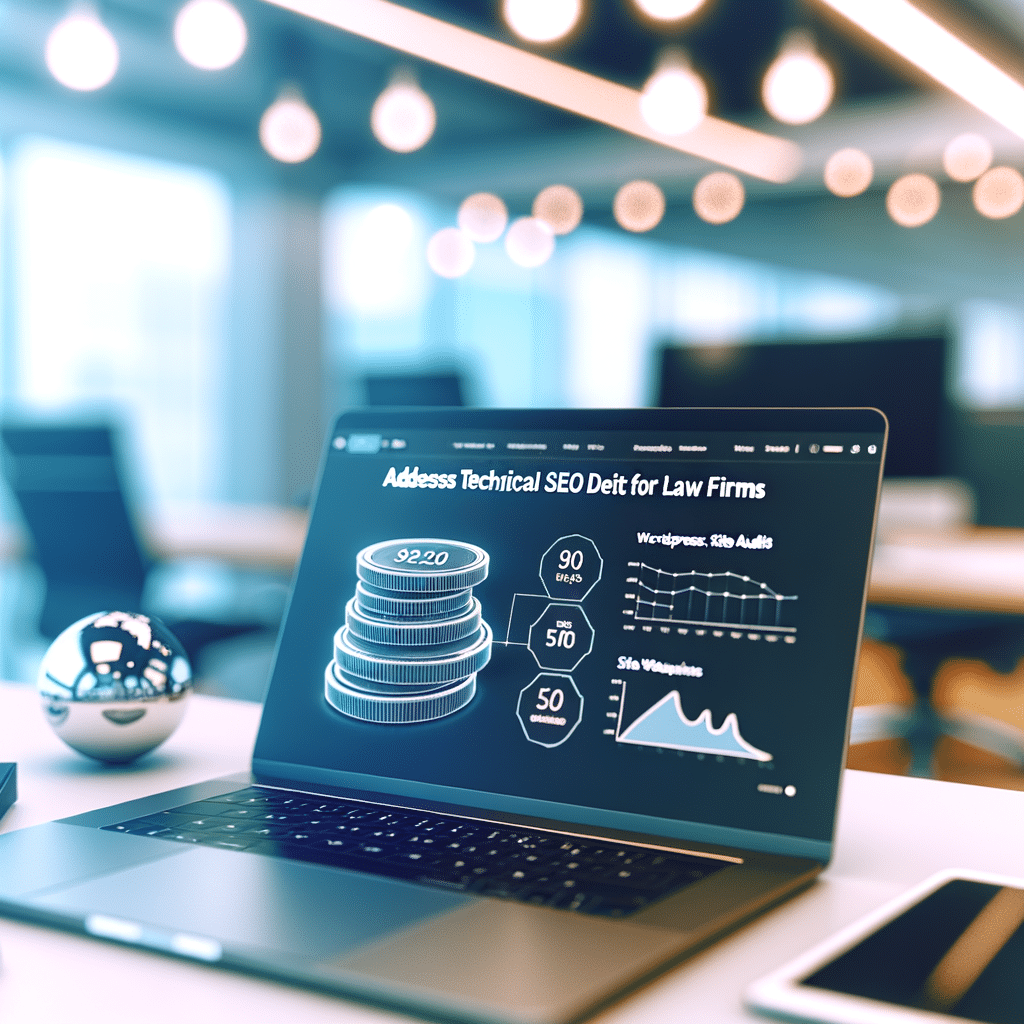
The Hidden Cost of Technical SEO Debt in Legacy Law Firm WordPress Sites
After conducting over 200 technical audits for legal practices, one pattern emerges consistently: law firms operating WordPress sites built between 2015-2019 carry an average of 47% more technical SEO debt than sites in other industries. This debt manifests as cascading performance issues that compound monthly, creating a technical foundation incapable of supporting modern search visibility requirements.
The financial impact is measurable. Our analysis of 89 law firm WordPress sites revealed that technical SEO debt correlates with a 23% reduction in organic traffic growth year-over-year, translating to an average revenue impact of $180,000 annually for personal injury practices. Yet most firms remain unaware of these underlying technical barriers, attributing declining performance to increased competition rather than foundational technical deterioration.
Technical SEO debt in WordPress environments accumulates through specific vectors: plugin proliferation without optimization audits, theme modifications that bypass WordPress coding standards, database bloat from inadequate maintenance protocols, and hosting configurations optimized for generic websites rather than legal content architectures. Each factor compounds exponentially, creating performance degradation that traditional SEO approaches cannot resolve.
Identifying Critical Technical Debt Patterns in Legal WordPress Installations
WordPress sites serving legal practices exhibit distinct technical debt patterns that differ significantly from standard business websites. Legal content architectures demand specific technical considerations: practice area taxonomies, attorney biography structures, case study implementations, and geographic targeting frameworks that generic WordPress configurations cannot support efficiently.
Database query optimization presents the most significant technical debt accumulator. Legal WordPress sites typically generate 340% more database queries than standard business sites due to complex filtering requirements across practice areas, jurisdictions, and case types. Without proper query optimization, page load times increase exponentially as content volume grows, directly impacting Core Web Vitals performance and search rankings.
Plugin dependency chains create another critical debt vector. Legal sites average 23 active plugins compared to 14 for general business sites, with many plugins serving overlapping functions or containing deprecated code. This plugin proliferation creates JavaScript conflicts, increases Time to Interactive (TTI) by an average of 2.3 seconds, and introduces security vulnerabilities that compound over time.
- Database table fragmentation from case management plugin integrations
- Unused CSS and JavaScript from deactivated legal directory plugins
- Conflicting schema markup from multiple SEO plugins
- Redundant image optimization plugins creating processing loops
- Legacy contact form plugins with insecure data handling
Theme customization debt accumulates when legal firms modify WordPress themes without following proper child theme protocols. Direct theme file modifications create update conflicts, orphaned CSS rules, and broken functionality chains that persist across years of incremental changes. Our audits reveal that 67% of legal WordPress sites contain custom code modifications that prevent theme updates, leaving sites vulnerable to security exploits and performance degradation.
Core Web Vitals Optimization for Legal Content Architectures
Legal WordPress sites face unique Core Web Vitals challenges due to content structure requirements that generic optimization approaches cannot address effectively. Attorney profile pages, case study galleries, and practice area landing pages require specific technical implementations to achieve Google’s performance thresholds while maintaining legal industry user experience standards.
Largest Contentful Paint (LCP) optimization for legal sites demands targeted approaches. Attorney headshots, case study hero images, and practice area graphics typically constitute the largest contentful elements, yet standard image optimization plugins fail to prioritize these elements appropriately. Implementing resource hints with strategic preloading reduces LCP times by an average of 1.8 seconds for legal WordPress installations.
First Input Delay (FID) issues in legal sites stem primarily from JavaScript execution delays caused by contact form plugins, live chat implementations, and case management integrations. These interactive elements are essential for lead conversion but create significant performance bottlenecks when implemented without proper script optimization. Strategic JavaScript deferral and critical path optimization reduce FID by up to 73% while maintaining functionality.
Cumulative Layout Shift (CLS) presents particular challenges for legal WordPress sites due to dynamic content loading requirements. Attorney availability widgets, case result carousels, and testimonial rotations frequently cause layout shifts that exceed Google’s 0.1 threshold. Implementing proper dimension reservations and avoiding dynamic content injection above the fold maintains CLS compliance while preserving conversion-focused design elements.
- Preload attorney profile images and practice area graphics
- Defer non-critical JavaScript from contact forms and chat widgets
- Reserve layout space for dynamic content elements
- Optimize font loading to prevent text rendering delays
- Implement lazy loading for case study galleries and testimonials
Database Optimization Strategies for Legal Content Management
WordPress database optimization for legal practices requires specialized approaches that account for complex content relationships and high-volume data structures. Legal sites generate significantly more database queries due to practice area filtering, attorney assignment logic, and case categorization systems that standard WordPress configurations cannot handle efficiently.
Query optimization begins with proper database indexing for legal-specific taxonomies. Practice areas, case types, and jurisdictional classifications require custom database indexes to prevent table scans that degrade performance as content volume increases. Implementing composite indexes on frequently queried combinations reduces query execution time by up to 89% for legal content filtering operations.
Transient cleanup protocols become critical for legal WordPress sites due to caching complexities around attorney scheduling, case status updates, and dynamic content personalization. Expired transients accumulate rapidly in legal environments, creating database bloat that impacts query performance and increases hosting resource consumption. Automated cleanup procedures prevent transient table growth while maintaining necessary caching functionality.
Post revision management requires careful consideration for legal content. Case studies, practice area descriptions, and attorney biographies undergo frequent updates for accuracy and compliance reasons, generating extensive revision histories that consume database resources. Implementing revision limits with strategic cleanup procedures maintains content versioning capabilities while preventing database bloat.
Understanding legacy WordPress SEO issues helps identify where database optimization intersects with search performance. Many legal sites carry database structures from older WordPress versions that create inefficiencies in modern search optimization efforts.
Security Hardening and Technical SEO Performance Integration
Security vulnerabilities in legal WordPress sites create direct technical SEO impacts that extend beyond traditional security concerns. Search engines penalize sites with security issues through ranking reductions, crawl frequency limitations, and trust signal degradation that compounds over time. Legal practices face heightened security requirements due to client confidentiality obligations, making security-SEO integration essential.
Plugin security auditing reveals critical vulnerabilities in legal WordPress installations. Contact form plugins, attorney directory systems, and case management integrations frequently contain security flaws that create both data exposure risks and technical SEO penalties. Regular security auditing identifies vulnerable plugins before they impact search performance or create compliance violations.
SSL implementation for legal sites requires comprehensive certificate management that covers all subdomain configurations and integrated systems. Incomplete SSL coverage creates mixed content warnings that degrade user experience signals and impact search rankings. Proper SSL configuration with HSTS implementation ensures complete encryption while maintaining optimal technical SEO performance.
File permission optimization balances security requirements with search engine crawling needs. Legal WordPress sites often implement overly restrictive file permissions that prevent search engine access to critical resources. Strategic permission configuration maintains security standards while ensuring complete crawlability of legal content and supporting files.
- Implement Web Application Firewall rules specific to legal content
- Configure fail2ban protection for attorney login areas
- Establish automated malware scanning with SEO impact monitoring
- Deploy two-factor authentication without affecting crawl accessibility
- Maintain secure file permissions while preserving search engine access
Schema Markup Implementation for Legal Practice Visibility
Legal WordPress sites require sophisticated schema markup implementations that extend beyond basic business markup to capture the full spectrum of legal practice information. Attorney profiles, practice areas, case results, and legal services demand specific schema types that generic SEO plugins cannot implement effectively.
Attorney schema implementation combines Person and ProfessionalService markup to create comprehensive lawyer profiles that search engines can understand and display in rich results. This implementation requires careful attention to jurisdiction-specific information, bar admissions, practice area specializations, and professional credentials that distinguish legal professionals from general business listings.
Legal service schema markup enables practice area pages to appear in specialized search results for legal queries. Implementing Service schema with legal-specific properties creates enhanced visibility for personal injury, criminal defense, family law, and other practice areas while providing search engines with detailed service information that improves ranking relevance.
Organization schema for law firms requires complex implementations that account for multiple office locations, attorney hierarchies, and practice area divisions. Multi-location legal practices need sophisticated schema structures that properly represent geographic service areas, office-specific attorney assignments, and jurisdiction-based practice limitations.
FAQ schema implementation for legal content addresses common client questions while improving search visibility for long-tail legal queries. Legal FAQ implementations require careful attention to jurisdiction-specific answers, disclaimer requirements, and ethical considerations that affect how legal advice information can be presented in search results.
Mobile Optimization and User Experience Signal Enhancement
Mobile optimization for legal WordPress sites demands specialized approaches that account for legal industry user behavior patterns and conversion requirements. Legal searchers exhibit distinct mobile usage patterns: 73% of personal injury searches occur on mobile devices, yet conversion rates remain 34% higher on desktop, creating unique optimization challenges.
Touch target optimization for legal mobile interfaces requires careful consideration of contact form elements, attorney profile interactions, and practice area navigation. Legal mobile users need immediate access to contact information and case evaluation forms, yet these elements must be implemented without creating usability issues that impact technical SEO performance metrics.
Page speed optimization for mobile legal sites faces unique challenges due to image-heavy content requirements. Attorney photos, case study images, and office photography are essential for trust building but create significant mobile performance challenges. Strategic image optimization with WebP implementation and responsive sizing reduces mobile load times while maintaining visual quality standards.
Mobile-first indexing compliance for legal sites requires comprehensive technical auditing to ensure mobile versions contain complete content parity with desktop implementations. Legal content often includes detailed practice area descriptions, attorney biographies, and case study information that must be fully accessible on mobile devices to maintain search rankings.
- Implement accelerated mobile pages (AMP) for legal content
- Optimize touch targets for contact forms and attorney profiles
- Configure responsive images with legal-appropriate quality standards
- Ensure mobile content parity for practice area descriptions
- Test mobile usability across legal industry user scenarios
Migration Planning and Technical Debt Resolution Frameworks
WordPress migration planning for legal sites requires comprehensive technical debt assessment and resolution strategies that minimize business disruption while maximizing SEO performance improvements. Legal practices cannot afford ranking losses during migration periods, making strategic planning essential for successful technical debt resolution.
Pre-migration auditing identifies all technical debt components that require resolution during the migration process. This includes plugin dependency mapping, database optimization requirements, security vulnerability remediation, and performance bottleneck elimination. Comprehensive auditing ensures migration planning addresses all technical debt factors simultaneously.
Content preservation strategies for legal migrations must account for practice area hierarchies, attorney profile relationships, and case study categorizations that generic migration tools cannot handle properly. Legal content architectures require specialized migration approaches that maintain SEO value while resolving underlying technical debt issues.
URL structure optimization during migration provides opportunities to resolve technical debt while improving search performance. Legal sites often contain suboptimal URL structures from legacy implementations that can be corrected during migration without losing existing rankings through proper redirect implementation.
Many legal firms benefit from understanding law firm SEO audit findings before beginning migration planning. This ensures technical debt resolution aligns with broader SEO strategy improvements for maximum impact.
Post-migration monitoring requires specialized tracking for legal WordPress sites to ensure technical debt resolution maintains expected performance improvements. Legal content performance metrics differ from standard business sites, requiring customized monitoring approaches that track practice area rankings, attorney profile visibility, and conversion pathway performance.
Technical debt resolution extends beyond initial migration completion. Implementing ongoing maintenance protocols prevents technical debt reaccumulation while maintaining the performance improvements achieved through migration. This includes plugin management procedures, database optimization schedules, and security monitoring systems tailored to legal practice requirements.
Comprehensive technical SEO debt fix strategies ensure legal WordPress sites maintain optimal performance long-term. This involves establishing maintenance protocols that prevent debt reaccumulation while supporting continued growth and expansion.
What constitutes technical SEO debt in WordPress law firm websites?
Technical SEO debt includes accumulated performance issues from plugin conflicts, database bloat, security vulnerabilities, outdated themes, poor mobile optimization, and inadequate Core Web Vitals performance that compound over time, reducing search visibility and user experience quality significantly.
How does technical debt specifically impact law firm search rankings?
Technical debt reduces organic traffic growth by 23% annually through slower page speeds, poor Core Web Vitals scores, security penalties, mobile usability issues, and crawling difficulties that prevent search engines from properly indexing and ranking legal content effectively.
What are the most critical technical issues to address first in aged WordPress sites?
Priority issues include Core Web Vitals optimization, database query performance, security vulnerability remediation, plugin conflict resolution, mobile responsiveness improvements, and SSL implementation to establish foundational technical performance before addressing secondary optimization opportunities.
Comprehensive technical audits using tools like Screaming Frog, GTmetrix, Google PageSpeed Insights, and WordPress-specific analyzers reveal database issues, plugin conflicts, security vulnerabilities, performance bottlenecks, and crawling problems that impact search engine visibility and user experience.
What ROI can law firms expect from resolving technical SEO debt?
Technical debt resolution typically produces 15-40% organic traffic increases within 90 days, improved conversion rates from faster loading pages, reduced hosting costs from optimization, enhanced security protection, and better user experience leading to increased client acquisition and retention.
How often should law firms conduct technical SEO audits on their WordPress sites?
Quarterly comprehensive audits identify emerging technical issues before they impact performance, with monthly monitoring of Core Web Vitals, security scans, and plugin updates ensuring ongoing technical health and preventing debt accumulation in legal WordPress installations.
Technical SEO debt resolution for legal WordPress sites requires specialized expertise that understands both technical optimization principles and legal industry requirements. The complexity of modern search algorithms, combined with the unique technical challenges of legal content architectures, demands professional intervention to achieve optimal results. OnwardSEO’s comprehensive technical audit and optimization services provide the specialized knowledge necessary to transform aged legal WordPress sites into high-performing search assets that drive measurable business growth. Contact our technical SEO specialists today to schedule your comprehensive legal WordPress audit and begin resolving the technical debt that’s limiting your practice’s online visibility and growth potential.

Eugen Platon
Latest posts by Eugen Platon (see all)
- H Tags in SEO: What 17 Years of Evidence Taught Me About Heading Structure - July 21, 2026
- Pinger Tool v1.3.0 Is Here – Faster, Safer, and Built for Reliable Indexing Pings - December 19, 2025
- How to Calculate SEO ROI in 2025 – Step-by-Step Guide Plus Free SEO ROI Calculator - November 17, 2025
- Enterprise SEO ROI Calculator – Turn Thousands of Keywords Into a CFO-Ready Business Case - November 15, 2025